
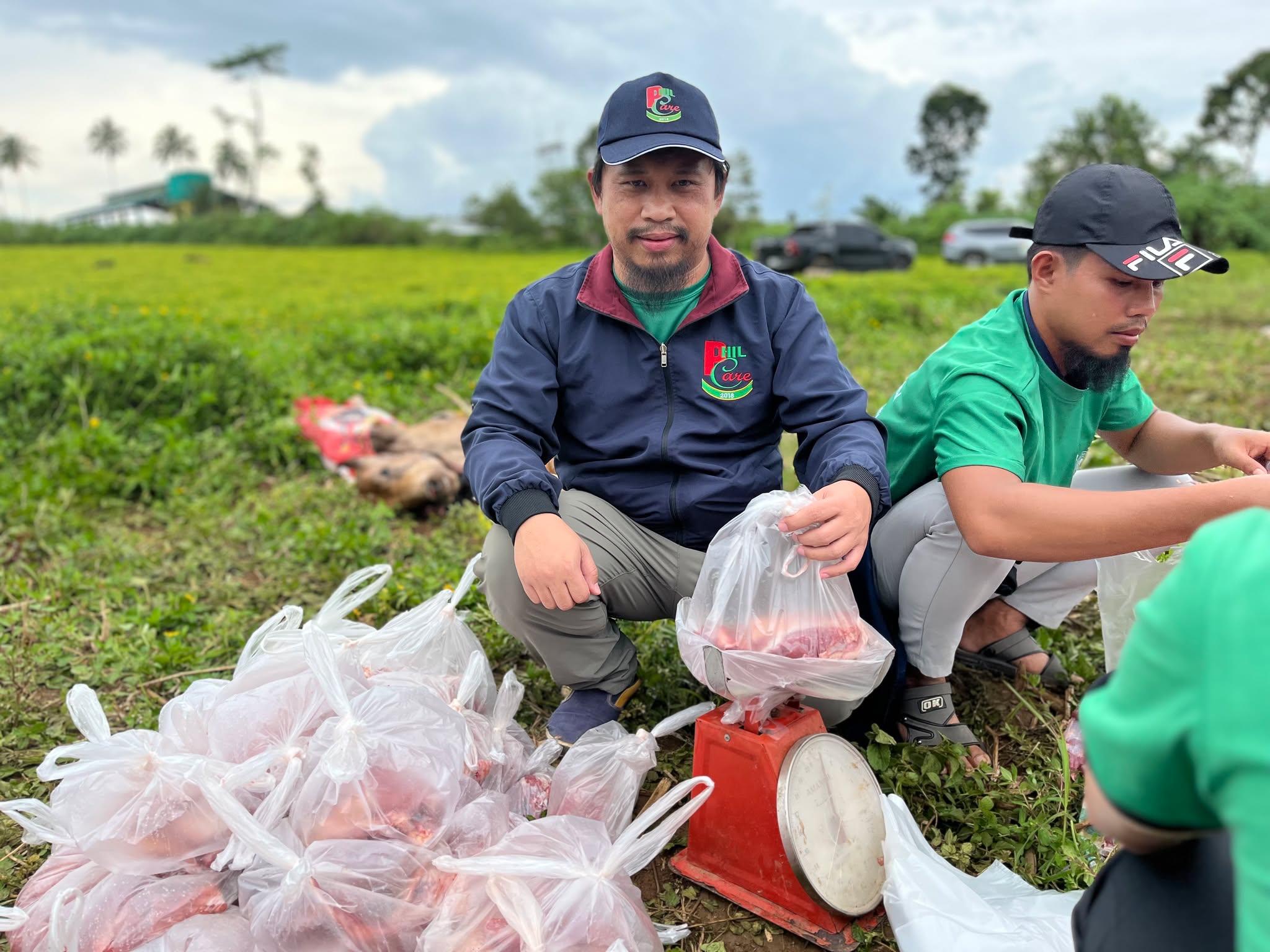
Eid al-Adha Qurbani Programme
A recurring seasonal PHILCARE programme that facilitates Qurbani during Eid al-Adha and distributes Qurbani meat to vulnerable families and underserved communities, extending the benefits and joy of the occasion through dignified food assistance.
- Location
- Selected communities across the Philippines
- Timeline
- Implemented since 2018
- Region
- Bangsamoro (BARMM), Davao Region, SOCCSKSARGEN, Northern Mindanao
Challenge
Poverty, limited income, and livelihood insecurity continue to affect the ability of many vulnerable families in the Philippines to meet diverse food needs, particularly in parts of Mindanao and the Bangsamoro region, where economic pressures may intersect with the effects of displacement, disasters, and fragile livelihoods. Eid al-Adha and Qurbani hold particular religious and social significance for Muslim communities. Beyond the act of worship itself, Qurbani is associated with feeding others, sharing, solidarity, and enabling members of the community to participate in the joy and benefits of Eid. For families and individuals experiencing greater economic vulnerability, whose access to meat may be limited or irregular, the distribution of Qurbani meat provides seasonal food assistance with practical and social value and helps extend the joy and benefits of Eid to them with dignity.
Response
PHILCARE implements the Qurbani Programme through early planning for the Eid al-Adha cycle, identifying priority communities and beneficiaries, procuring suitable cattle and sheep, and organizing slaughter, meat preparation, and distribution within the prescribed period for Qurbani. When market conditions are favorable, PHILCARE seeks to procure animals several days before Eid to obtain better value for available resources and reduce exposure to potential seasonal price increases, while ensuring appropriate care, feeding, and shelter for the animals until slaughter. Before implementation, PHILCARE identifies target areas, intended beneficiaries, and anticipated quantities to support an orderly and equitable distribution process. Because slaughter, preparation, and distribution must be completed within the prescribed Qurbani period, PHILCARE coordinates in advance with suppliers, butchers, relevant workers, volunteers, community leaders, and local institutions, while taking into account applicable Shariah requirements, health and meat-safety considerations, documentation, and beneficiary dignity. Based on assessed need and available resources, the programme prioritizes more vulnerable families and individuals and seeks to reach remote and underserved communities where access to Qurbani assistance may be limited. This approach helps PHILCARE direct Qurbani meat toward communities where needs are greater while adapting procurement, slaughter, and distribution arrangements to the local context and resources available in each programme cycle.
Impact
The Qurbani Programme provides direct seasonal food assistance by making Qurbani meat available to participating families and individuals, including those whose access to meat may be limited or irregular because of their economic circumstances. Beyond its nutritional value, the programme helps extend the benefits of Qurbani and the joy of Eid al-Adha to more vulnerable families with dignity, while providing a practical expression of sharing, solidarity, and care for others associated with the occasion. In mixed communities, the humanitarian benefit of Qurbani meat distribution may also extend to vulnerable non-Muslim families where this is consistent with the applicable Shariah guidance and the conditions of the particular project. This reflects values of good neighborliness, compassion, and community solidarity while preserving the religious character of Qurbani and the dignity of those receiving assistance. The programme also seeks to extend assistance to remote and underserved communities where access to such support may be limited. Through repeated implementation over the years, PHILCARE has developed practical experience in early planning, animal procurement, local coordination, volunteer mobilization, and the management of slaughter, meat preparation, and distribution within the required timeframe, supporting more organized and accountable delivery of seasonal assistance.
Project updates
PHILCARE implemented three Qurbani projects during Eid al-Adha 2026, reaching a combined 535 families through the distribution of Qurbani meat. The programme was implemented through partnerships with Human Appeal Australia via MyCARE Malaysia, Human Initiative Indonesia, and MyGuide Malaysia. The Human Appeal Australia/MyCARE-supported component reached 350 families through 10 cattle, producing approximately 700 kilograms of meat. Human Initiative Indonesia supported assistance reaching 115 families, while the MyGuide Malaysia component reached 70 families, equally distributed between Marogong and Marawi City.
PHILCARE continued its Qurbani Programme in 2025, reaching 1,800 families in Saguiaran and Marawi City, Lanao del Sur. Qurbani meat was distributed to participating families as seasonal food assistance during Eid al-Adha, extending the benefits of the occasion to households and communities served by the programme.
PHILCARE implemented its 2024 Qurbani Programme in selected communities in Mindanao, reaching 855 families in Bacolod-Kalawi and Marawi City, Lanao del Sur; Naawan, Misamis Oriental; and Sapad, Lanao del Norte. The programme included families affected by the Marawi Siege who were residing in government-provided permanent and temporary shelters in Marawi City. In Naawan, the distribution also reached Muslim reverts from the municipality and neighboring areas, as well as vulnerable non-Muslim families, extending the humanitarian benefit of Qurbani meat to people in need within a mixed community.
PHILCARE implemented its 2023 Qurbani Programme in selected areas of Lanao del Sur, Lanao del Norte, and Cotabato City, reaching a total of 940 families through the distribution of Qurbani meat. The programme served poor and vulnerable households and included house-to-house distribution, assistance delivered through selected madrasahs for students and religious teachers, and targeted support for Muslim reverts. Documented activities also extended assistance to beneficiaries from communities neighboring Marawi City. The annual total of 940 families reflects PHILCARE's consolidated programme record; individual project records available for the year document several components of the wider annual implementation.
PHILCARE implemented its 2022 Qurbani Programme in selected communities in Marawi City, Tugaya, Bacolod-Kalawi, Maguing, and Binidayan, Lanao del Sur; Iligan City; and Cagayan de Oro City, reaching 150 families through the distribution of Qurbani meat. The programme provided seasonal food assistance to participating families during Eid al-Adha, extending the benefits and joy of the occasion to families in need in selected communities in Mindanao.
PHILCARE implemented its 2021 Qurbani Programme in selected communities in Marawi City, Lanao del Sur, reaching 650 families through the distribution of Qurbani meat. The institutional record identifies the implementation period as July 2021. The programme provided seasonal food assistance during Eid al-Adha, helping extend the benefits of Qurbani and the joy of the occasion to families in need.
PHILCARE continued its Qurbani Programme in 2020 despite the operational challenges of the COVID-19 pandemic, reaching 500 families in selected communities in Marawi City and Bacolod-Kalawi, Lanao del Sur, and Iligan City through the distribution of Qurbani meat. PHILCARE's consolidated records confirm the 500-family reach and continuation of Qurbani activities during the pandemic year. The programme provided seasonal food assistance during Eid al-Adha, helping extend the benefits and joy of Qurbani to families in need during a period of heightened social and economic disruption.
PHILCARE implemented its 2019 Qurbani Programme in selected communities in Marawi City, Lanao del Sur, reaching 320 families through the distribution of Qurbani meat. The 320-family annual reach is reflected in PHILCARE's institutional records. The programme provided seasonal food assistance during Eid al-Adha, extending the benefits and joy of Qurbani to families in need.
PHILCARE first implemented its Qurbani Programme in 2018 in Marawi City, Lanao del Sur, reaching 425 beneficiaries through the distribution of Qurbani meat. The original records use beneficiaries, rather than families, so that unit should remain unchanged. The programme was implemented during the early post-conflict recovery period, when some residents had begun returning to selected barangays of Marawi City while many families continued to face displacement and humanitarian needs. PHILCARE's 2018 institutional record confirms that displacement and humanitarian needs remained significant during this period. The Qurbani distribution provided seasonal food assistance during Eid al-Adha and helped extend the benefits and joy of the occasion to people affected by the continuing consequences of the Marawi crisis.