
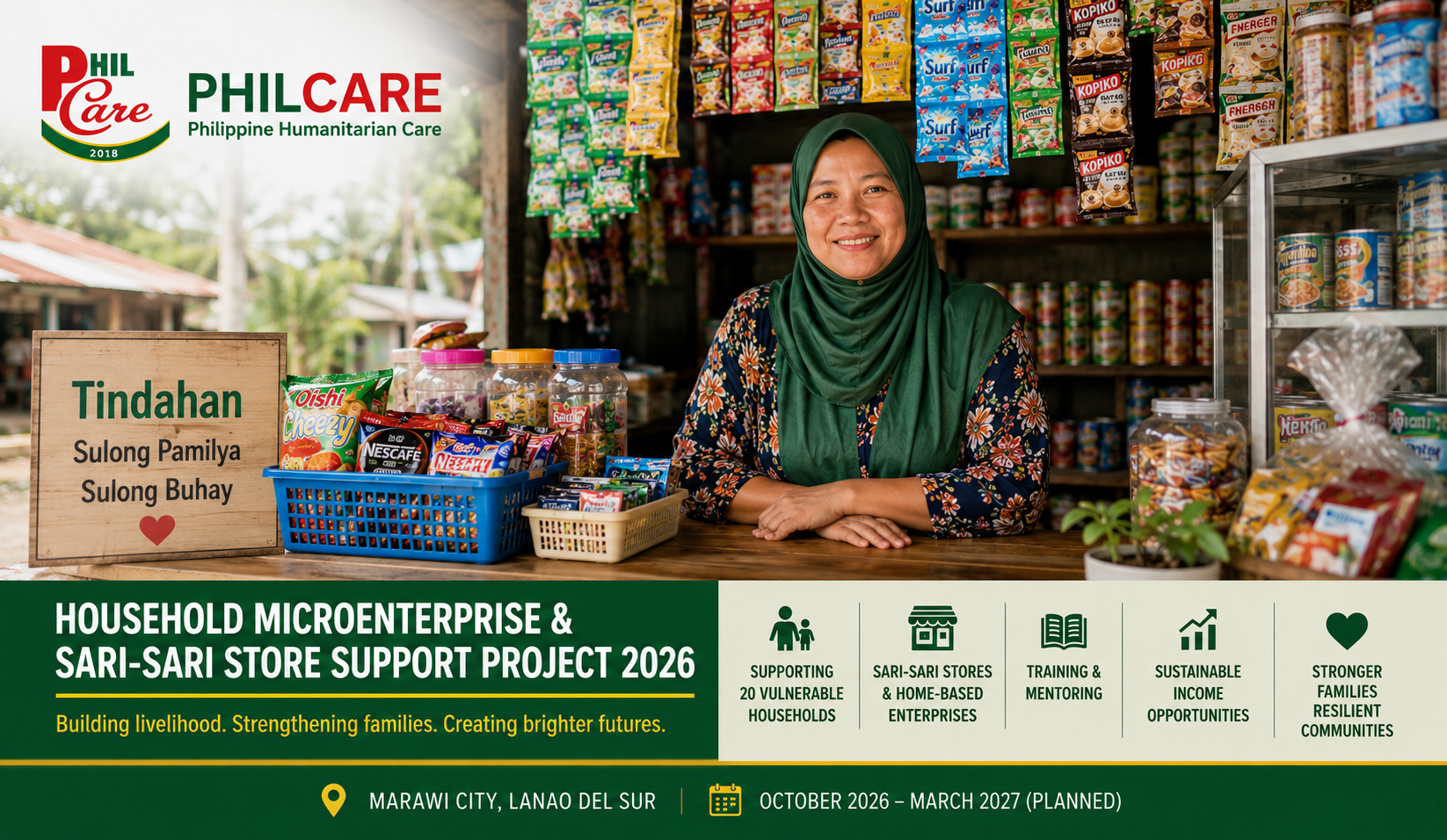
Household Microenterprise & Sari-Sari Store Support Project 2026
A six-month livelihood initiative supporting 20 vulnerable households in Marawi City to establish or strengthen viable home-based microenterprises through tailored productive assistance, practical business training, and structured mentoring.
- Location
- Marawi City, Lanao del Sur, BARMM
- Timeline
- October 2026 – March 2027
- Region
- Bangsamoro (BARMM)
Challenge
Vulnerable households in Marawi City often face unstable and limited income opportunities, making it difficult to meet essential household needs and build greater economic resilience. While small home-based enterprises can provide accessible livelihood opportunities, many households face barriers such as insufficient productive capital, limited inventory, weak business management practices, and difficulty identifying viable opportunities within their local market. Effective livelihood assistance therefore requires more than providing start-up capital or business goods. It requires careful household selection, market-sensitive livelihood planning, appropriate productive inputs, practical business skills, and sustained follow-up to help households protect and reinvest their working capital.
Response
PHILCARE will support 20 vulnerable households in Marawi City through a structured household livelihood and microenterprise initiative designed to strengthen income-generating opportunities and household economic resilience. The project will provide tailored livelihood support based on each household’s needs, capacities, existing experience, and local market opportunities. Home-based sari-sari stores will serve as a primary livelihood modality, alongside the strengthening of existing viable household microenterprises where appropriate. Participating households will receive productive business inputs and practical training in pricing, inventory management, simple recordkeeping, working-capital management, responsible credit practices, and reinvestment. Structured mentoring and monitoring will continue throughout the six-month project period to help households address business challenges and strengthen their livelihood practices. Beneficiary selection will combine household vulnerability, livelihood readiness, and business feasibility, helping ensure that assistance is matched with households that have both demonstrated economic need and a realistic opportunity to operate a viable livelihood activity. The project has an estimated total budget of ₱605,000–₱645,000, covering livelihood assistance, beneficiary assessment, business training, implementation, mentoring, monitoring, accountability, and project management.
Impact
The project targets 20 vulnerable households with tailored livelihood assistance designed to establish or strengthen functioning home-based microenterprises. By the end of the six-month implementation period, the project aims for at least 80% of supported businesses to remain operational, at least 70% to demonstrate restocking from business proceeds, and at least 80% to demonstrate continued productive use of livelihood capital and maintain usable basic business records. Beyond business start-up, the project seeks to strengthen participating households’ capacity to manage productive resources, reinvest in their livelihood activities, and generate meaningful contributions to household income. The pilot will also provide PHILCARE with documented learning and evidence to guide the development and responsible expansion of future household livelihood and economic empowerment initiatives.